
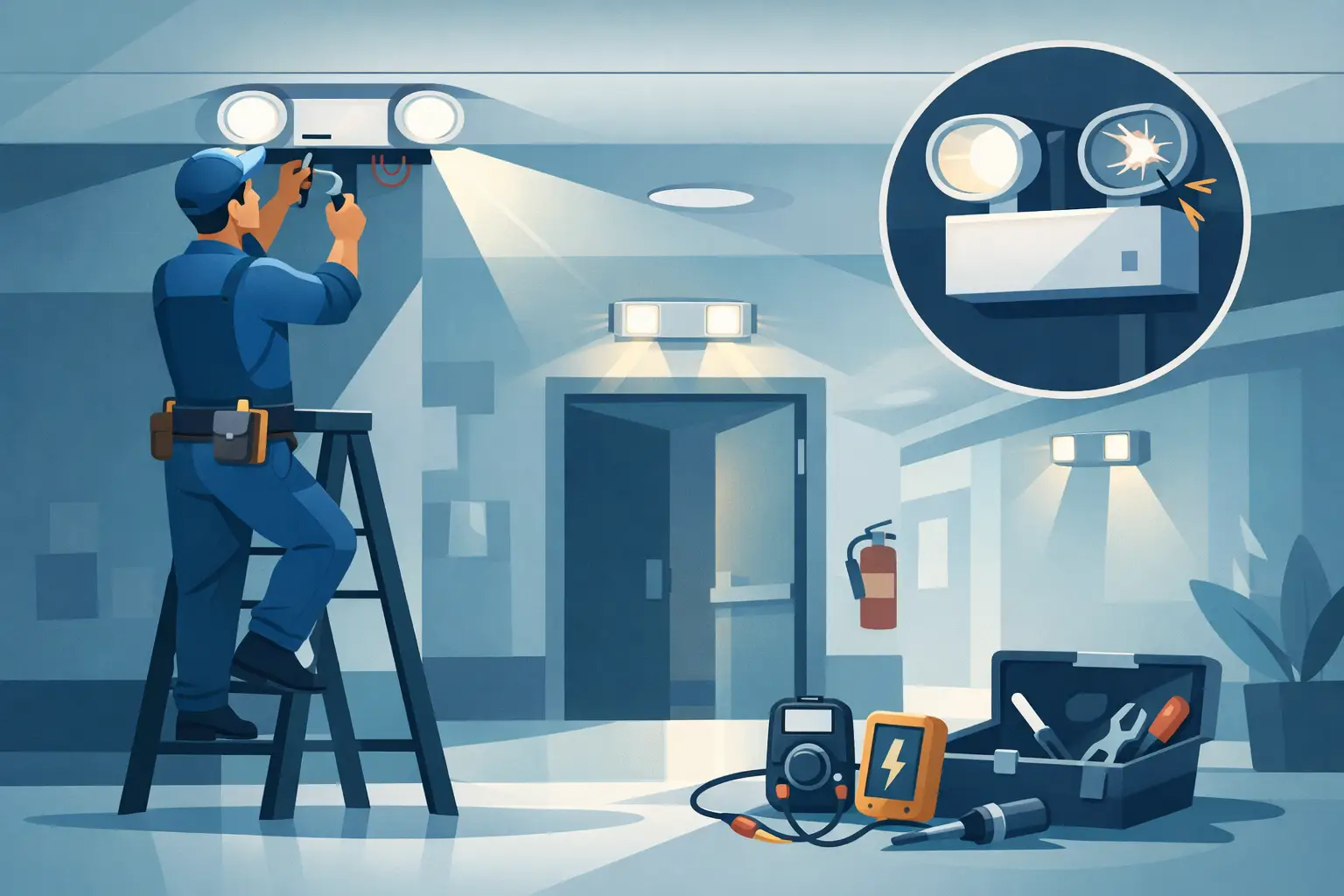
A failed emergency light can look like a small maintenance issue until the main power goes out. Then it becomes the difference between a clear exit route and a dark, confusing building. Commercial emergency lighting repairs help businesses keep escape routes, stairs, corridors, and exit doors safely illuminated when normal lighting fails.
For a shop, office, warehouse, rental property, or shared commercial building, these fittings should not be treated as ordinary lights. They are part of the building’s life-safety provisions. When one is flashing, dim, damaged, or failing a test, it needs proper attention rather than a quick cosmetic fix.
Why emergency lighting failures need prompt attention
Emergency lighting is designed to operate from a backup power source during an outage or electrical fault. Some fittings remain lit at all times, while others switch on only when the normal supply is lost. Both types rely on components that wear out, including batteries, charging circuits, lamps, LEDs, control gear, and connections.
A fitting may appear normal during day-to-day use but still fail when it is needed. A green charging indicator can be on even though the battery no longer holds enough charge for the required operating period. That is why a visual check alone is not enough to prove a system is working properly.
The consequences of a fault depend on the premises. In a small office, one failed unit might leave a short corridor poorly lit. In a larger workplace, several failed fittings can create gaps along an evacuation route. Either way, leaving faults unresolved can put staff, visitors, and customers at risk and may create issues during a fire-safety inspection or after an incident.
Common signs that repairs are needed
Emergency lighting problems are not always obvious, but there are a few signs building owners and managers should take seriously. A unit that does not illuminate during a functional test is the clearest warning. So is a fitting that comes on but quickly fades, flickers, or looks much dimmer than the surrounding units.
Other warning signs include a damaged diffuser, water marks around the fitting, a missing or cracked exit sign, loose wiring, a constant fault indicator, or a unit that stays on when it should return to charging mode. If a fitting has been painted over, knocked by stock or equipment, or blocked by new shelving or signage, it may no longer do its job properly even if the lamp still works.
Battery failure is especially common in older self-contained units. Rechargeable batteries have a limited service life, and heat, cold, repeated discharge, and poor charging conditions can shorten it further. Replacing the battery may be the right answer, but not every issue is a battery issue. A failed charger, faulty driver, damaged supply cable, or unsuitable replacement part can produce similar symptoms.
Commercial emergency lighting repairs start with the right diagnosis
The most useful repair is one based on testing and fault finding, not guesswork. An electrician should first establish what type of system is installed and which areas it is intended to cover. This could be individual self-contained fittings, maintained exit signs, emergency bulkheads, or a centrally supplied system serving several locations.
The next step is to test the fitting safely. This may involve simulating a loss of normal power, checking whether the emergency lamp operates, assessing battery condition, and confirming that the unit recharges correctly afterward. Where several lights are affected, the electrician will also check the circuit, protective devices, switching arrangements, and any shared supply issue.
A single defective light may be straightforward. A pattern of failures usually deserves closer attention. For example, if multiple units on the same floor fail together, the cause may be a supply fault rather than several unrelated bad batteries. If fittings fail prematurely in a kitchen, plant room, or warehouse, heat, moisture, vibration, or the wrong fitting type may be part of the problem.
This is where a practical repair approach saves money. Replacing every fitting without identifying the cause can be expensive and unnecessary. On the other hand, repeatedly changing batteries in outdated or damaged units can become false economy. The sensible option depends on the condition of the system, the age of the fittings, the availability of compatible parts, and the needs of the building.
Repair or replace?
A repair is often suitable when the fitting body is sound and the problem is limited to a battery, lamp, LED module, connection, or charging component. It can be a cost-effective way to restore a relatively modern system.
Replacement is usually the better choice when fittings are badly damaged, no longer provide suitable light output, have recurring faults, or use parts that are difficult to source. Modern LED emergency fittings can also reduce routine lamp changes and provide clearer, more reliable illumination. However, the cheapest unit is not automatically the best option. The fitting must be suitable for its location, mounting position, operating environment, and required duration.
What a proper repair visit should cover
Commercial emergency lighting repairs should do more than make a fault light disappear. The work should restore the fitting’s intended emergency operation and check that it is not creating another safety issue.
A thorough visit may include inspecting the fitting and its supply, replacing defective components or the complete unit where needed, testing operation under emergency conditions, checking recharge status, and making sure the exit route remains properly covered. If access equipment is needed for high ceilings, this should be planned safely rather than treating the job as a quick ladder task.
It is also worth checking changes within the building. A remodeled office, partition wall, altered warehouse layout, or relocated exit can affect where emergency lighting is needed. Repairs are a good opportunity to spot areas that have become poorly covered since the system was first installed.
For businesses across Middlesbrough, Teesside, and the wider North East, BS Electrical can assess faults clearly and explain whether a targeted repair or replacement offers the better value. The aim is straightforward: safe lighting, honest advice, and work done properly the first time.
Testing and record keeping matter after the repair
Repairing a failed unit is only one part of keeping emergency lighting dependable. Regular checks help identify weak batteries and developing faults before an emergency exposes them. The exact testing schedule and duration should suit the premises and its applicable safety requirements, but routine functional checks and periodic full-duration testing are commonly expected.
Testing should be planned carefully. A full discharge test can leave fittings recharging for a period afterward, so it should not be carried out at a time when the building may need full emergency coverage. In premises that operate late, receive the public, or have staff working alone, timing matters.
Keep a clear record of tests, faults found, repairs completed, replacements installed, and any areas needing further work. A log gives building managers a useful maintenance history and shows that issues have been acted on. It also makes future fault finding quicker, especially where several people are responsible for the site.
When to call an electrician
Call for professional help if emergency lights do not operate during testing, batteries fail to hold charge, fault indicators remain on, several fittings fail together, or there is any sign of overheating, water damage, burning smells, or damaged wiring. Do not ignore a light simply because another nearby unit is working. Escape routes need consistent coverage, not occasional pools of light.
It is also sensible to arrange an inspection after a power surge, electrical work, flooding, renovation, or a change to the layout of your premises. These events can affect circuits, fittings, and the usefulness of the existing lighting plan.
Emergency lighting should be quiet reassurance built into the building, not a last-minute concern. A repaired and tested fitting gives people a clearer, safer route out when normal lighting is no longer there.