
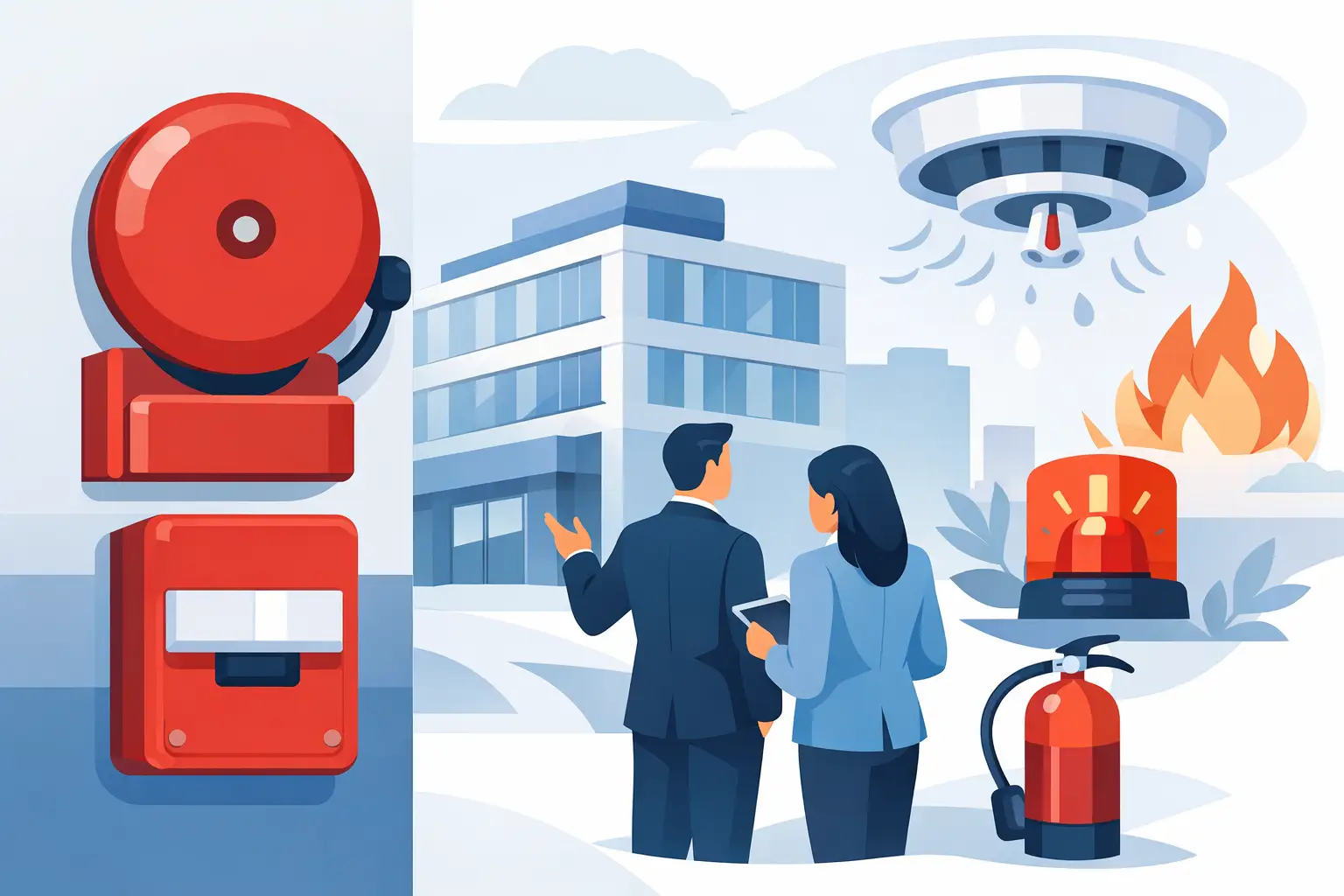
A fire alarm is not simply a row of red devices on the wall. For a business owner, it is the system that gives people time to get out, helps limit damage, and supports a faster emergency response. This commercial fire alarm guide explains what to consider before installing, replacing, or maintaining a system at your premises.
The right setup depends on your building, how it is used, how many people are inside, and the risks present on site. A small office, busy restaurant, warehouse, apartment building, and medical practice should not automatically have the same fire alarm design.
Start With the Risks in Your Building
A proper fire alarm system begins with a fire risk assessment, not a product catalog. The assessment identifies likely ignition sources, combustible materials, escape routes, people who may need assistance, and areas where a fire could develop without being noticed quickly.
For example, a commercial kitchen may need detection that can cope with heat, steam, and cooking fumes without causing frequent false alarms. A warehouse may have high ceilings, racking, loading equipment, and isolated areas that need careful detector placement. A small shop may need a more straightforward arrangement, but still needs clear warning throughout the property and a safe way to alert staff and customers.
False alarms are not just inconvenient. They interrupt work, affect customers, and can lead people to take future alarms less seriously. At the same time, reducing alarms by removing detectors or choosing unsuitable devices creates a much bigger safety problem. The aim is reliable early warning, without unnecessary disruption.
What Makes Up a Commercial Fire Alarm System?
Most systems combine detection, manual activation, audible and visual warnings, a control panel, and backup power. The control panel is the central point of the system. It receives signals from detectors and manual pull stations, identifies the affected area where the system is designed to do so, activates alarms, and may communicate with a monitoring service.
Smoke detectors are common in offices, hallways, retail areas, and general circulation spaces. Heat detectors can be a better fit where smoke, dust, or vapor are part of normal operations. Manual pull stations allow someone who sees a fire to raise the alarm immediately. Horns, sounders, strobes, or voice evacuation equipment warn occupants to leave.
Battery backup matters because a fire alarm must continue operating during a power outage. The system should also be clearly labeled, protected from accidental damage, and accessible for testing and servicing.
Conventional or Addressable Systems?
A conventional system groups devices into zones. When an alarm is activated, the panel identifies the zone, such as the ground floor, rear warehouse, or first-floor offices. This can be suitable for smaller, simpler buildings where staff can quickly investigate the area shown.
An addressable system identifies the individual device or exact location that has activated. It generally provides more detailed information and can make fault finding, maintenance, and incident response easier in larger or more complex buildings. It can cost more initially, but may save time and reduce uncertainty over the life of the system.
Neither option is automatically best. For a modest unit with a simple layout, a conventional system may be practical and cost-effective. For multi-floor premises, sites with multiple departments, or buildings with longer travel distances, addressable equipment is often worth serious consideration.
Plan for People, Not Just Floor Space
Fire alarm design is about how people move through a building. An alarm needs to be heard or seen in toilets, stock rooms, break areas, basement spaces, corridors, and any place where someone could be working alone. Noise from machinery, music, extraction systems, or busy public areas can affect whether an audible alarm will be noticed.
Visual alarms may be needed where hearing protection is used, background noise is high, or occupants could have hearing impairments. In some settings, voice messages offer clearer direction than a standard alarm tone. A message telling people to leave by the nearest safe exit can be especially useful in larger public buildings, though it must be designed correctly and maintained just as carefully as the rest of the system.
Do not overlook visitors, contractors, customers, or new staff. They may not know the building layout or the evacuation plan. Clear fire action notices, visible escape routes, and regular staff training work alongside the alarm system. One cannot fully replace the other.
Compliance Is More Than Passing an Inspection
Commercial premises are usually subject to local fire codes, building rules, insurance conditions, and requirements set by the authority having jurisdiction. The exact requirements vary by location and building type, so a generic online checklist cannot confirm that a particular system is compliant.
A qualified fire alarm professional should assess the premises, confirm the appropriate design approach, install equipment to applicable standards, and provide the records you need. Those records may include drawings, test results, device locations, operating instructions, and service documentation.
If you lease your premises, clarify responsibility early. A landlord may be responsible for the building-wide system, while the tenant is responsible for daily checks, staff procedures, or changes within an occupied unit. Do not assume the other party is handling it. Put responsibilities in writing and keep maintenance records available.
Insurance providers can also have specific expectations, particularly for vacant buildings, higher-value stock, overnight operations, or sites where a fire could spread quickly. Monitoring may be advisable or required in these situations.
Monitoring Can Add Protection After Hours
A monitored fire alarm can send a signal to a central station or designated contacts when the system activates or develops a fault. This can be valuable when a building is unoccupied overnight, at weekends, or during holiday periods.
However, monitoring does not remove the need for sound detection, evacuation procedures, or regular testing. It also needs reliable communications, clear call-out arrangements, and an up-to-date list of keyholders. If the monitoring path fails or contact information is outdated, the protection is weaker than it appears on paper.
For a business that is occupied only during daytime hours, monitoring may be a sensible extra rather than an essential requirement. For a warehouse full of stock, a care setting, or a building with sleeping occupants, the case is often stronger. This is one of those decisions where the risk assessment, insurer, and local requirements should guide the final choice.
Installation Details That Prevent Future Problems
Good installation is not just about getting devices mounted neatly. Cables need appropriate protection and routing. Detectors should be positioned away from sources of contamination or airflow that could affect performance. Manual pull stations must be visible and accessible. Alarm devices need to be loud enough, or visible enough, in the areas they serve.
The installer should also consider future access. A detector placed above a fixed ceiling feature, tall storage rack, or difficult-to-reach machine will be harder and more expensive to service. Small decisions at installation stage often determine whether maintenance is straightforward or becomes a recurring headache.
If your business is being renovated, changing its layout, adding storage, or converting rooms to new uses, review the fire alarm system before work begins. New partitions can block sound. A former office may become a workshop with different environmental conditions. An extension may create escape routes and risks the original design never covered.
Testing and Maintenance Keep the System Dependable
A fire alarm can look perfectly fine while having a fault, weak backup batteries, contaminated detectors, or a communication issue. Regular testing and scheduled professional maintenance are how these issues are found before an emergency.
Staff should know how to carry out routine checks safely and record them in the logbook. This normally includes testing a different manual pull station in rotation and confirming that the alarm is received throughout the building. Occupants should be warned before a planned test, particularly where alarms could affect customers, neighboring businesses, or vulnerable people.
Professional servicing goes further. It checks devices, panel condition, batteries, alarm outputs, fault reporting, and any monitoring connection. The service frequency depends on the system, local requirements, and the building’s risk profile, but skipping it to save money is a false economy. A documented maintenance history also gives landlords, insurers, and inspectors confidence that the system has been looked after.
Choosing the Right Contractor
Ask who will survey the building, who will complete the installation, what documentation will be supplied, and how faults or urgent call-outs are handled. A clear quote should explain the scope of work rather than simply state a total price for “fire alarm installation.”
The lowest quote can be tempting, but compare like for like. One proposal may include a full assessment, suitable detection, commissioning, certification, staff handover, and ongoing support. Another may only cover basic equipment and installation. The difference matters when the system has to perform under pressure.
For businesses across Middlesbrough, Teesside, and the wider North East, BS Electrical takes a practical approach: assess the site properly, explain the options in plain language, and make sure the work is done correctly the first time.
A fire alarm system should give you confidence without becoming something you have to think about every day. The best next step is a site-specific assessment that turns your building’s real risks, working patterns, and evacuation needs into a system your staff can rely on when it matters.