
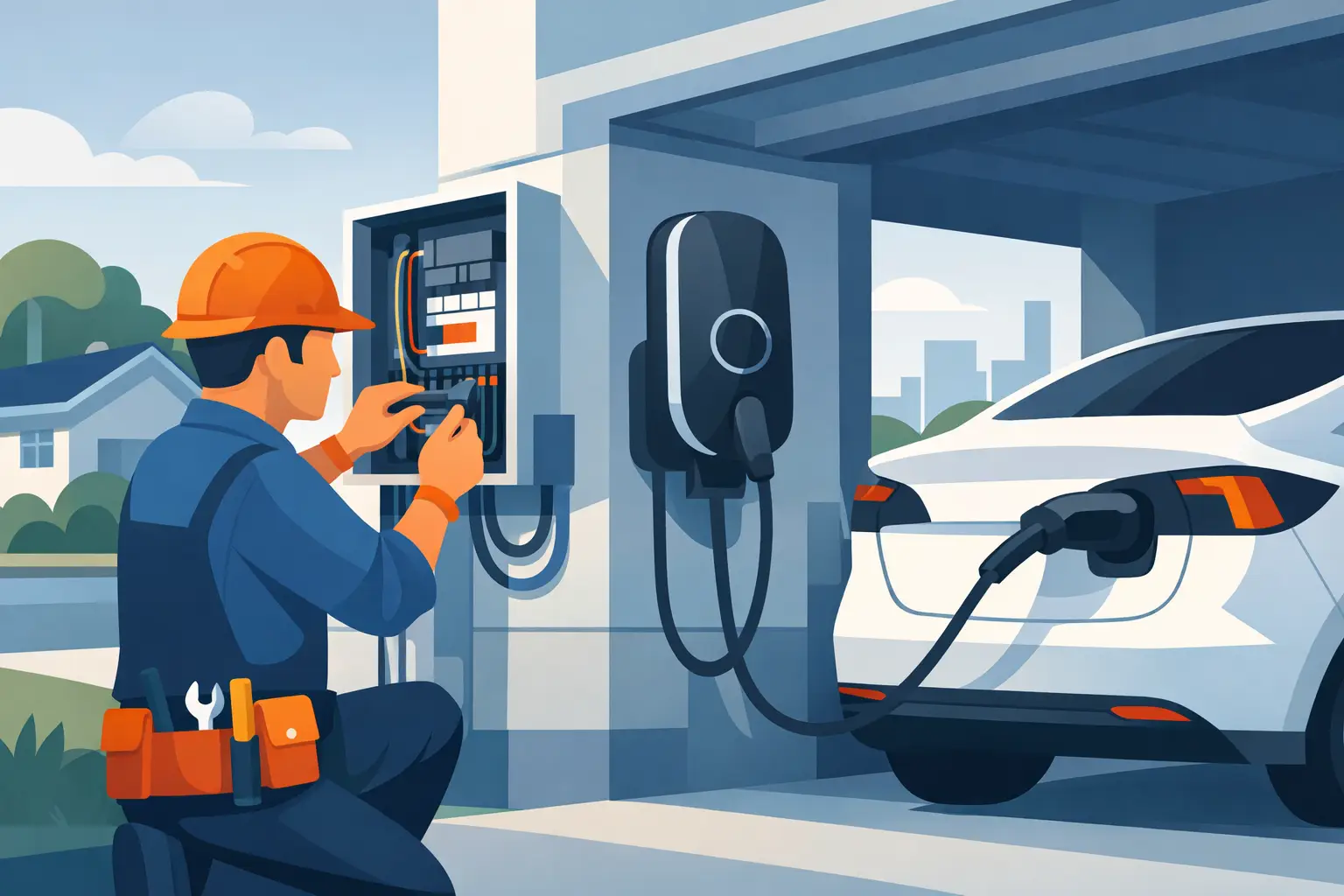
Pulling into your driveway with a new EV is exciting. Realizing the charger setup involves your panel, wiring, breaker size, permits, and outdoor power is usually the moment people ask, do I need an electrician to install an EV charger?
In most cases, yes – you do. A Level 2 EV charger is not the same as plugging in a kitchen appliance. It draws a significant amount of power for long periods, and that means the installation needs to be sized correctly, protected properly, and connected safely to your home’s electrical system.
Do I Need an Electrician to Install an EV Charger?
If you are installing a Level 2 charger, the safest and most practical answer is yes. A licensed electrician can check whether your panel has enough capacity, confirm the right circuit size, install the correct breaker and wiring, and make sure the charger is mounted and connected properly.
There are some situations where people get confused. Many EVs come with a basic Level 1 charger that plugs into a standard household outlet. If you are only using that manufacturer-supplied plug-in cord exactly as intended, and the outlet is already in good condition on a suitable circuit, you may not need a new installation. But the moment you want faster charging, a new 240-volt circuit, or a hardwired charger, this moves into electrician territory.
Why EV charger installation is not a simple DIY job
An EV charger might look straightforward on the wall, but the real work is behind it. The charger has to be matched to the electrical supply available at the property. That includes your service size, existing panel load, breaker space, wire run length, and whether the charger will be indoors or outdoors.
A charger that is oversized for the circuit, or installed with the wrong wire gauge, can cause overheating and nuisance tripping at best. At worst, it can create a serious fire risk. Even if everything appears to work at first, hidden problems often show up later after repeated charging cycles.
There is also the issue of code compliance. EV charging equipment has specific installation requirements, and local permitting may apply depending on where you live. A qualified electrician handles those details so you are not left guessing whether the setup is safe or legal.
Level 1 vs. Level 2 charging
This is where a lot of homeowners can save themselves time by understanding the difference.
Level 1 charging uses a standard 120-volt outlet. It is slow, but for some drivers it is enough. If you only drive short distances and can leave the car charging overnight every night, Level 1 may work.
Level 2 charging uses 240 volts and charges much faster. This is what most homeowners want after a few weeks of real EV ownership. It is more convenient, more practical for larger batteries, and often essential for households with higher daily mileage. It also usually requires a dedicated circuit installed by an electrician.
If your plan is to charge one car overnight reliably and not think about it too much, Level 2 is normally the better long-term choice. That is also the point where professional installation becomes the sensible option.
What an electrician actually checks before installing an EV charger
A proper EV charger install starts with the home, not the charger box.
First, the electrician looks at your main electrical panel. Some homes have plenty of spare capacity. Others are already close to their limit, especially if they have electric heating, air conditioning, hot tubs, or newer kitchen appliances. If the panel is full or undersized, the solution may involve a load calculation, a panel upgrade, or load management equipment.
Next comes the circuit design. The charger’s power rating determines the breaker size and wire size required. The distance from the panel to the charger matters too. A longer cable run can affect material choice and installation cost.
Then there is the charger location. A garage install is often more straightforward than an outdoor wall mount or a detached structure. Outdoor chargers need equipment and connections suitable for the environment, and the mounting position should be convenient without leaving cables stretched across walkways or drive areas.
A good electrician also checks the grounding and bonding of the system and makes sure the equipment is installed according to the manufacturer’s instructions. That part matters more than people realize. Even quality chargers can become unreliable if installed incorrectly.
Hardwired or plug-in charger?
This depends on your charger model, your electrical setup, and how you plan to use it.
A plug-in charger connects to a 240-volt receptacle, much like a heavy-duty appliance. A hardwired charger is wired directly into the electrical circuit with no plug or outlet. Both can be valid options, but hardwired units are often favored because they are tidy, secure, and well suited for higher power charging.
Plug-in setups can be useful if you want the option to disconnect or replace the charger more easily later. But the outlet itself must still be installed correctly on a dedicated circuit, which is not a shortcut around hiring an electrician. It is still electrical installation work, and it still needs to be done properly.
Can I install an EV charger myself?
Technically, some homeowners may be allowed to carry out certain electrical work depending on local rules. That does not mean it is a good idea.
The problem is not just making the charger turn on. The problem is making sure the full system is safe under continuous load, compliant with local code, and suitable for years of regular use. EV charging is a high-demand application. A mistake with breaker sizing, terminations, wire selection, or panel loading is not always obvious straight away.
There is also the question of insurance, home resale, and warranty issues. If a charger is installed incorrectly and causes damage, DIY work can become expensive very quickly. For most people, this is one of those jobs where paying for professional installation saves money and hassle in the long run.
Signs your home may need extra electrical work
Not every EV charger install is a simple one-day job. Some homes need additional work before the charger can be installed safely.
If your panel is older, already crowded, or still uses outdated equipment, that can be a sign you need an upgrade. If breakers trip regularly, lights dim when large appliances start, or you already know the home has limited capacity, it is worth addressing that before adding a charger.
Older homes are especially worth checking carefully. They may not have enough spare electrical capacity for a new 240-volt circuit without changes elsewhere. That does not mean you cannot have an EV charger. It just means the installation needs to be planned properly rather than rushed.
What affects the cost?
The charger itself is only one part of the total cost. Installation pricing can vary quite a bit depending on the property.
The biggest factors are usually the distance from the panel to the charger location, whether the charger is hardwired or plug-in, the amperage required, and whether your panel needs upgrading. A straightforward garage install close to the panel is usually more affordable than an exterior install with a long cable run or trenching work.
Permits and inspections may also add to the overall cost depending on your area. That is another reason it helps to work with an experienced electrician. You get a clearer picture of the full job rather than a low estimate that leaves out important parts.
Choosing the right electrician for the job
When you are comparing installers, look for someone who is experienced with residential EV charger installations, not just general electrical work. The best approach is a contractor who explains the options clearly, checks your panel properly, and gives you a straightforward quote based on your property rather than a one-size-fits-all price.
You also want someone who will tell you if your chosen charger or location is not ideal. Honest advice matters here. A good electrician is not just there to put a box on the wall. They are there to make sure the charger works safely, reliably, and conveniently for how you actually live.
For homeowners who want a no-nonsense local service, BS Electrical takes that practical approach – clear advice, safe installation, and work done properly the first time.
The bottom line on EV charger installation
If you are asking do I need an electrician to install an EV charger, the answer is almost always yes for anything beyond basic Level 1 charging. A home EV charger is a real electrical installation, not a gadget setup. It needs proper planning, safe connections, and the right protection behind the scenes.
The good news is that once it is installed correctly, charging at home becomes one of the easiest parts of owning an EV. Get the setup right at the start, and the whole thing feels simple every day after that.