
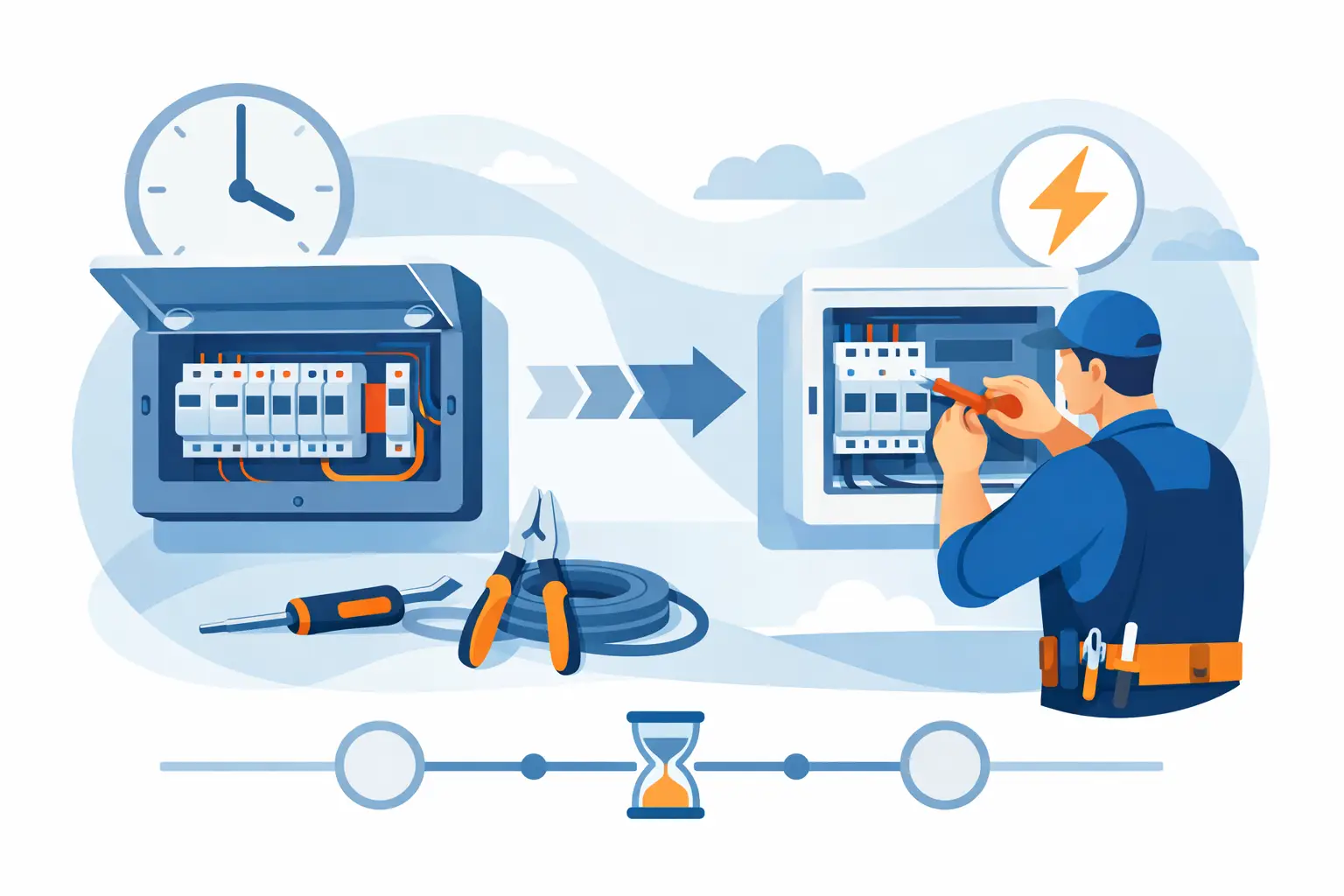
A fuse board replacement is rarely a job that should be rushed, but it usually does not mean days without power either. A typical fuse board replacement timeline for a straightforward home can often be completed within one working day. The real answer depends on the condition of the existing wiring, the size of the property, and what testing reveals once the work begins.
For homeowners, landlords, and business owners, knowing what happens before, during, and after the installation makes the day far less disruptive. The aim is simple: replace an outdated or unsafe board with a modern consumer unit, test the installation properly, and leave you with electrical protection you can rely on.
Why the Fuse Board Replacement Timeline Can Vary
The fuse board is the central point that distributes electricity around a property. Older boards may use rewireable fuses or early-style circuit breakers, while a modern consumer unit uses devices designed to disconnect power quickly if a fault is detected.
Replacing the board itself may look straightforward. However, an electrician cannot safely fit a new unit without checking that the circuits connected to it are suitable. A new board can reveal faults that were already present but had not caused an obvious problem, such as damaged cables, poor connections, missing earthing, or circuits that do not test correctly.
That is why a dependable electrician will avoid promising an exact finish time before seeing the installation. Most jobs are completed on schedule, but allowing time for proper testing protects your property and avoids cutting corners.
Before the Replacement: Survey, Quote, and Planning
The process should begin with an assessment of your existing fuse board and the electrical installation around it. This may be a short visit or a detailed discussion, depending on the property and the information available.
The electrician will look at the board’s age, the number of circuits, access to the work area, the condition of cables, and whether you have additions such as an electric shower, electric heating, outdoor supplies, a garage, solar equipment, or an EV charger. These can all affect the type and size of consumer unit required.
For a landlord or property manager, it is also sensible to consider the property’s current electrical inspection status. If the installation is older or its history is unclear, testing before the replacement may be recommended. It can identify likely issues in advance and give a more realistic idea of the time and budget needed.
Once the scope is clear, you should receive a straightforward quote explaining what is included. This should cover the new consumer unit, installation, testing, certification, and any known additional work. If possible repairs may be uncovered during testing, a good quote will explain that clearly rather than hiding it in vague wording.
How to prepare for installation day
You do not need to do much, but a little preparation helps the job run smoothly. Clear access around the fuse board and make sure the electrician can reach the main electrical supply safely. If the board is in a cupboard, move stored items out beforehand.
Because the power will be switched off for part of the day, charge phones, laptops, and medical equipment where appropriate. Plan around refrigerated food, home working, electric heating, internet routers, and alarm systems. If you run a business from the property, arrange the work for a quieter day where possible.
What Happens on the Day of a Fuse Board Replacement
For many standard homes, the physical replacement and testing take around six to eight hours. Power will normally be off for much of that period, although the exact downtime varies with the complexity of the circuits and the testing results.
The electrician will first isolate the supply, confirm it is safe to work on, and carefully label the existing circuits. The old board is then removed, and the new consumer unit is installed with the correct protective devices for the property.
A modern unit commonly includes circuit breakers and residual current protection. These are designed to reduce the risk of electric shock and protect cables and appliances in the event of certain faults. The right arrangement depends on the installation, so it should be selected based on the circuits present rather than treated as a one-size-fits-all upgrade.
After fitting the board, each circuit must be tested. This is not an optional final check. Testing confirms that the circuits operate correctly, protective devices disconnect as intended, polarity is correct, and earthing arrangements are satisfactory. The electrician will also identify and label each circuit clearly, so you know what controls lighting, sockets, kitchen appliances, alarms, outdoor power, and other areas.
A professional installation may take a little longer than you expected because testing takes time. That is a good sign. The board should not simply be fitted, switched back on, and left without confirming the safety of the circuits attached to it.
Common Reasons the Job Takes Longer
Most fuse board replacements are completed in a day, but some properties need extra work. The most common reason is that the existing wiring does not pass the required tests after the new board has been fitted.
An older property may have circuits with weak insulation readings, inadequate earthing, borrowed neutrals, damaged accessories, or old wiring methods that are no longer suitable. Sometimes a fault is limited to one circuit and can be repaired on the day. In other cases, the safest option is to isolate the affected circuit and arrange a return visit for repairs.
Additional time may also be needed when:
- The property has many circuits or several outbuildings.
- Access to the fuse board is restricted or the surrounding area needs making good.
- The main earthing and bonding need upgrading.
- Existing circuits have poor or unclear labeling.
- An alarm, EV charger, solar system, or specialist equipment needs coordinating.
These are not necessarily signs of poor workmanship in the original installation. Homes are altered over decades, often by different people, and older electrical systems were installed to standards that have changed over time. What matters is that any issue is explained plainly, with a safe and practical route forward.
When Will the Power Be Back On?
In a straightforward installation, power is typically restored toward the end of the working day once the board has been fitted and the circuits have passed testing. The electrician may restore circuits in stages where it is safe to do so, but you should plan for a significant period without electricity.
If a fault is found on one circuit, it may be possible to restore power to the rest of the property while leaving that circuit safely isolated. For example, a problematic outdoor socket circuit might be disconnected while lighting, kitchen circuits, and general outlets remain in use. This depends entirely on the fault and how the installation is arranged.
For a commercial property, a replacement may need to be scheduled outside trading hours or split into planned phases. Lost power can affect tills, refrigeration, computer systems, lighting, security, and machinery, so planning matters just as much as the installation itself.
Paperwork After a Fuse Board Replacement
Once the work is finished, you should receive the relevant electrical installation certificate and test results. Keep these documents with your property records. They are useful for future electrical work, insurance questions, property sales, and landlord compliance records.
The electrician should also walk you through the new board. You should know where it is, how to identify a tripped breaker, and when not to keep resetting it. A breaker that trips once after a known appliance fault may be straightforward. A breaker that repeatedly trips needs investigating, not forcing back on.
If your property needs follow-up repairs, ask for these to be set out clearly. You should understand which circuit is affected, whether it is currently safe to use, what the repair involves, and how soon it should be addressed.
Choosing the Right Time to Replace an Old Fuse Board
There is no value in waiting for a complete failure if your fuse board is clearly outdated, damaged, overloaded, or showing signs of recurring faults. Replacing it before adding an EV charger, electric shower, extension, new kitchen, or major security system can also make the wider project easier to plan.
BS Electrical takes a practical approach: inspect what is there, explain the work in plain language, and carry out the replacement properly rather than making promises that ignore the condition of the wiring. A clear quote and honest timeframe give you the confidence to plan the day without guessing.
The best time to book is when you can give the work the attention it deserves: clear access, a day with manageable power downtime, and enough room in the schedule to deal with any genuine issue testing uncovers. That is how a fuse board replacement becomes a sensible safety upgrade, not an unwelcome surprise.