
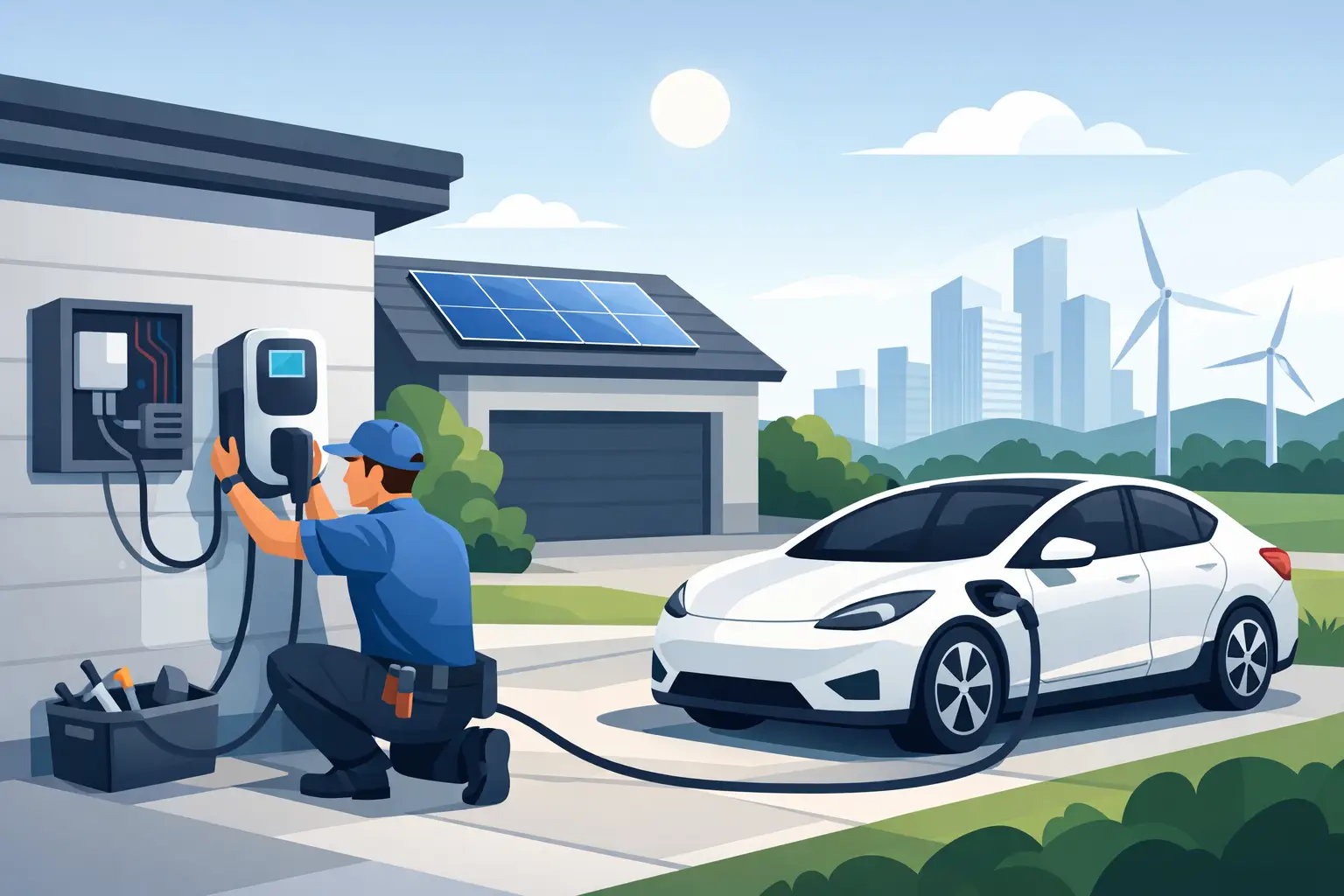
Pulling onto the driveway with a low battery is one thing. Realizing your home charging setup is too slow, poorly placed, or not up to code is another. This ev charger installation guide is for property owners who want the job done safely, sensibly, and without guesswork.
If you are planning an EV charger for your home, rental property, or business, the right setup depends on more than just picking a unit online. Charger speed, panel capacity, cable routing, parking layout, and local code requirements all affect what will work well long term. A proper installation should feel straightforward to use every day, not just look good on install day.
What this EV charger installation guide should help you decide
Most people start with one question – which charger do I need? In practice, there are usually three better questions. How quickly do you need to charge, where will the vehicle be parked most often, and can your existing electrical system support the added demand?
For many homes, a Level 2 charger is the sensible choice. It charges much faster than a standard wall outlet and is usually the sweet spot between convenience and cost. A regular outlet can work for some drivers with short daily mileage, but it is often too slow for households that rely on the vehicle every day. On the commercial side, the answer depends more on how the charger will be used. Staff parking, tenant use, fleet charging, and customer access all place different demands on the system.
There is no one-size-fits-all answer here. A detached home with a modern electrical panel is very different from an older property with limited capacity. A small business with one company EV has different needs than a site planning for multiple chargers in the next two years.
Choosing the right charger for the way you live or work
A lot of charger problems start with buying based on headline features rather than real use. Wi-Fi controls, app scheduling, and usage tracking can be useful, but they are not the first things to get right. Reliability, output, cable length, and weather suitability matter more.
At home, most drivers are well served by a Level 2 charger installed near their usual parking spot. If the charger is mounted too far away, if the cable has to stretch across a walkway, or if the unit sits where it is exposed to avoidable knocks, the setup quickly becomes annoying. Good placement saves hassle every single day.
For landlords and business owners, durability and access control often matter just as much as charging speed. If different users need access, a smart charger with monitoring features may make sense. If the goal is simply to keep one or two vehicles topped up overnight, a simpler setup may be the better value.
Power supply and panel capacity
This is the part many people do not think about until an electrician looks at the job. EV chargers draw a significant amount of power, especially Level 2 units. That means the existing panel, circuit capacity, and overall load on the property all need to be assessed properly.
Some properties can take a charger installation with minimal changes. Others may need a new breaker, a dedicated circuit, or a panel upgrade before the charger can be installed safely. That does add cost, but it is better to know that upfront than to force a charger onto a system that is already near its limit.
There are also cases where load management can help. If your property has high electrical demand from HVAC, cooking equipment, or other large appliances, an electrician may recommend a setup that balances charging demand more efficiently. That can be a smart alternative to a larger upgrade, depending on the building and how the charger will be used.
Best location for an EV charger installation
A good EV charger installation guide needs to cover placement, because this affects both cost and usability. The cheapest location is often near the electrical panel, but that is not always the best spot for day-to-day use. On the other hand, placing the charger far from the supply can increase cable runs, wall work, and labor time.
The aim is to find the practical middle ground. The charger should be easy to reach from the vehicle without trailing cables across paths or creating trip hazards. It should also be mounted at a sensible height and in a position that protects it from accidental damage. In garages, that is usually straightforward. Outdoors, weather rating and mounting surface become more important.
For businesses, charger location also affects traffic flow. You do not want charging bays that block access, create bottlenecks, or confuse customers. If more chargers may be added later, it is worth planning with future expansion in mind rather than treating the first install as a one-off.
Permits, code compliance, and safety
Any EV charger installation needs to meet local electrical code requirements. That is not red tape for the sake of it. A charger is a high-demand electrical appliance, and poor installation creates real safety risks.
Depending on the property and location, permits and inspections may be required. A qualified electrician should be able to advise on what applies, what documentation is needed, and whether the existing system needs work before installation starts. This is one of the biggest reasons to avoid DIY charger installs unless you are properly qualified to do that level of electrical work.
Safety also goes beyond the charger itself. Grounding, breaker sizing, cable protection, and the condition of the existing panel all matter. If the property already has older wiring, existing faults, or signs of overload, those issues should be dealt with before adding a charger.
What affects the cost
The charger itself is only one part of the price. Installation costs vary because properties vary. Distance from the panel, ease of cable routing, wall type, trenching needs, panel upgrades, permits, and charger specification all influence the final figure.
That is why quick online price ranges can be misleading. One home might need a straightforward install with a short cable run. Another might need a longer route, exterior mounting, and electrical upgrades to support the load. Both are EV charger installations, but they are not the same job.
For commercial properties, cost planning should also take future use into account. Installing one charger cheaply today can become expensive tomorrow if the site then needs to be reopened, rewired, or reconfigured for additional units. Sometimes spending a bit more now on capacity or layout saves money later.
What to expect on installation day
A professional install should not feel chaotic. In most cases, the electrician will confirm the charger position, isolate power as needed, run the new circuit, mount the charger, make the final connections, and carry out testing before handover. If permits or inspections are part of the process, those should be factored into the timeline.
You should also expect a clear explanation of how the charger works. That includes basic operation, any app setup if relevant, and advice on charging habits or maintenance. A good installer does not just fit the unit and leave. They make sure you know how to use it properly.
If your property needs additional electrical work first, that should be explained clearly before the install goes ahead. Honest advice matters here. It is better to hear that a panel needs attention than to be told everything is fine when it is not.
Homeowners, landlords, and businesses have different priorities
Homeowners usually care most about convenience, speed, and keeping the installation neat. Landlords often need a setup that is safe, durable, and easy to manage between tenants. Business owners may be thinking about staff use, customer experience, energy monitoring, or preparing for more EVs over time.
That is why a proper site assessment matters. The best charger on paper can still be the wrong fit if it does not match the property or the people using it. A local contractor with practical experience will usually spot issues early and suggest a setup that fits the building rather than forcing a generic solution.
For property owners who want an honest, no-nonsense approach, that matters more than sales talk. BS Electrical works with homeowners and businesses that want clear advice, safe workmanship, and an installation done properly the first time.
A few mistakes worth avoiding
The most common mistakes are usually simple ones. Choosing the cheapest charger without checking compatibility, installing it in the wrong place, underestimating electrical capacity, or treating the job like it is just another outlet upgrade can all lead to extra cost later.
It is also easy to think only about your current vehicle. If you expect another EV in the household, a change in tenancy, or business growth, it is worth mentioning that at the quote stage. A charger installation should suit the property for more than just the next few months.
The best results come from planning the job around real use. A charger that is safe, well-positioned, and correctly matched to the electrical system will save time and frustration every week you own it. If you are thinking about adding EV charging to your property, start with a proper assessment and make your next step the right one.