
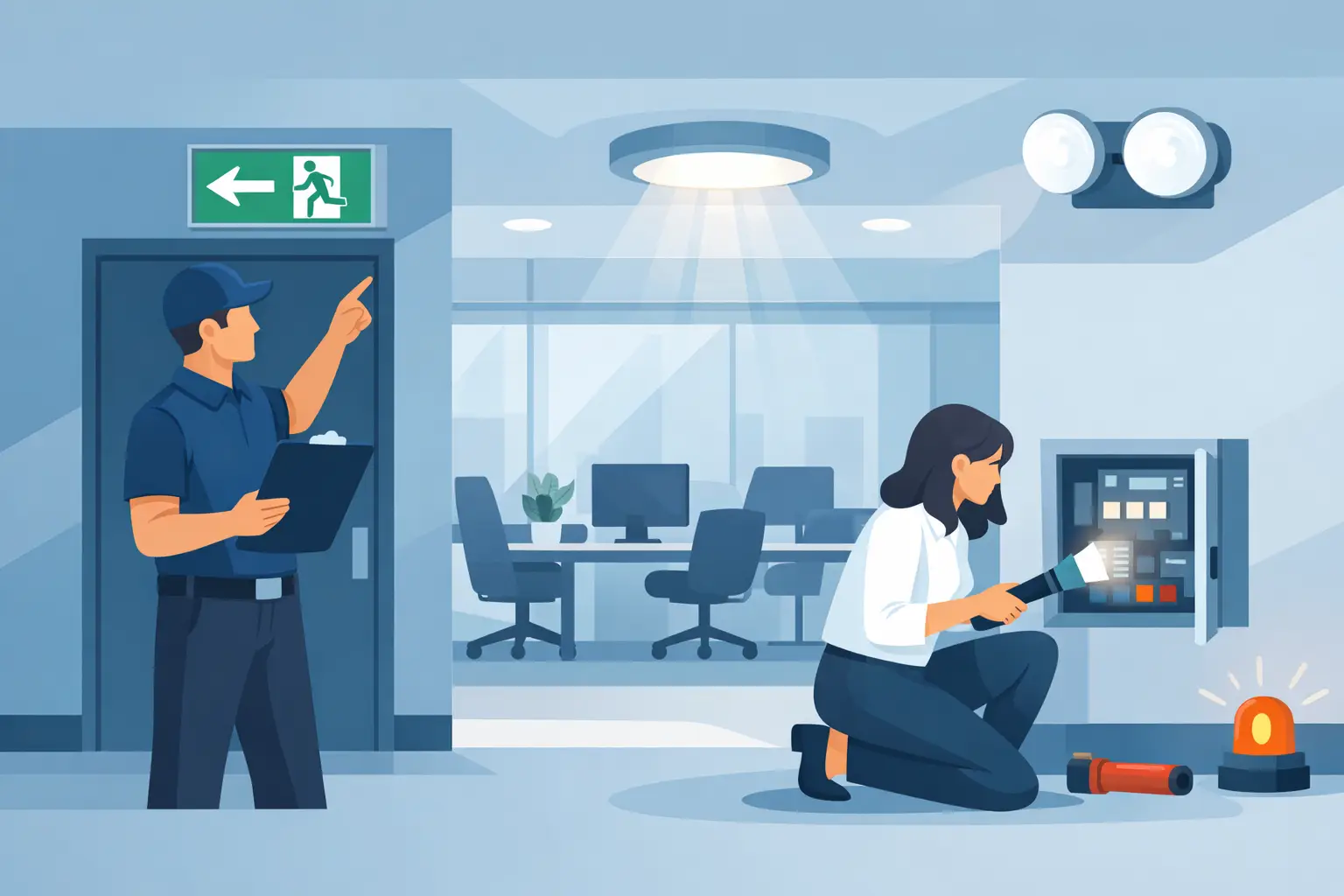
A power cut is not the moment to find out whether the emergency lights in your office work. Stairwells, corridors, fire exits, restrooms, and open-plan work areas can become unsafe quickly when normal lighting fails. Regular office emergency lighting testing gives your staff and visitors a clear, illuminated route out and gives you confidence that a small fault has not been left unnoticed.
For offices in Middlesbrough, Teesside, and across the North East, this is a practical part of looking after a workplace. It is not about creating paperwork for its own sake. It is about checking that emergency fittings, backup batteries, exit signs, and test systems will do the job they were installed to do.
What emergency lighting is designed to do
Emergency lighting takes over when the usual electrical supply fails. Depending on the layout of your premises, it may illuminate escape routes, final exits, stairs, changes in floor level, fire alarm call points, firefighting equipment, and high-risk work areas.
Most office systems use battery-backed fittings. These may look like regular light fittings or dedicated emergency units with a small indicator light. Maintained exit signs stay illuminated during normal operation and continue to work during a failure. Non-maintained fittings only come on when the normal supply is lost.
The right setup depends on the building. A small office with a straightforward route to the exit needs something different from a multi-floor building with internal rooms, shared corridors, storage areas, and several escape routes. In either case, every fitting must provide enough light for people to move safely without confusion or delay.
Why office emergency lighting testing should be routine
Emergency lights are easy to overlook because they spend most of their time in the background. Batteries age, charging circuits can fail, lamps can deteriorate, and fittings can be damaged during decorating, office moves, or other building work. A green indicator light alone does not prove that a unit will remain lit for the required period.
Testing identifies problems before there is an actual emergency. It also creates a record showing that the system has been checked and that faults have been acted on. That matters to the person responsible for the premises, whether that is a business owner, facilities manager, landlord, or managing agent.
There is also a common-sense business case. A failed fitting may be a quick repair when spotted early. Left until an inspection, evacuation drill, or real power failure, it can become a bigger disruption and leave parts of the office inadequately protected.
How often should emergency lighting be tested?
The test frequency and duration should suit the type of system, the premises, and the relevant fire safety requirements. In many commercial workplaces, a brief functional test is carried out monthly, with a longer full-duration test completed annually. Your fire risk assessment and existing maintenance records should help establish the right schedule.
Monthly functional checks
A monthly test normally simulates a mains power failure for a short period. This confirms that emergency lights and exit signs operate when required. The test should be long enough to check that the fittings illuminate, but not so long that batteries are unnecessarily discharged.
Walk the escape routes while the emergency lights are operating. Check that corridors, stairs, directional signs, and final exits can still be seen clearly. Look for fittings that are dim, flickering, damaged, blocked by furniture, or missing altogether.
Annual full-duration testing
The annual test is more demanding. The emergency lighting is operated for its full rated duration, commonly up to three hours, to confirm that the batteries have sufficient capacity. Because fittings may need time to recharge afterward, this test should be planned carefully.
A full-duration test is often best completed outside normal office hours or when the building is quiet. If the building needs to remain occupied before the batteries have recharged, temporary precautions may be needed. This is one reason many businesses arrange testing with a competent electrician rather than treating it as a quick switch-off-and-on exercise.
Extra checks after changes or faults
Do not wait for the next scheduled test if something changes. An office refit, partition wall, relocated fire exit, new storage layout, electrical work, water damage, or repeated tripping can all affect emergency lighting. A previously suitable fitting may no longer cover an altered escape route.
If an indicator shows a fault, a fitting fails a test, or an exit sign is no longer visible, arrange a repair promptly. Recording the fault without fixing it does not make the route safer.
A practical office emergency lighting testing checklist
A proper check looks beyond whether a lamp turns on. The person testing the system should confirm that each emergency fitting operates, remains lit for the appropriate test period, and provides useful illumination where it is needed.
They should also look at the condition of the fittings and surrounding areas. Emergency lights can be obscured by tall cabinets, signage, displays, or new partitions. Exit signs may point in the wrong direction after an office layout change. Dirt, damaged diffusers, loose covers, and outdated lamp types can all reduce performance.
The following details should be recorded in an emergency lighting logbook:
- The date and time of the test
- The areas and fittings tested
- The type and duration of the test
- Any faults found or lights that did not operate
- Repairs completed and the date they were resolved
- The name of the person carrying out the test
Keeping clear records makes future tests easier and helps spot repeat faults. It also means a new facilities manager, landlord, or office manager is not left guessing what has been checked.
Common faults found in offices
Battery failure is one of the most common issues, particularly with older fittings. A light may activate briefly but fade before the required duration has passed. In some cases, replacing the battery is sensible. In others, especially where fittings are old or parts are no longer readily available, replacement is the more reliable option.
Damaged or poorly positioned exit signs are another regular problem. A sign that is hidden behind a door, blocked by office furniture, or facing the wrong way offers little help during an evacuation. The same applies to emergency fittings installed before a change in room use or layout.
Some offices have systems that have gradually become a mixture of old and new fittings. They may still function, but maintenance becomes less straightforward and light levels can be inconsistent. An electrician can advise whether targeted repairs are enough or whether a planned upgrade will provide better long-term value.
When to bring in a qualified electrician
Basic monthly checks can often be managed by a trained responsible person on site, provided they understand the system and keep accurate records. Repairs, annual duration testing, fault diagnosis, alterations, and replacement work should be handled by a qualified electrician with commercial experience.
This is particularly worthwhile if your office shares a building, has several floors, includes windowless internal rooms, or has changed layout over time. Emergency lighting has to work alongside the building’s fire strategy, not simply fill a ceiling with fittings.
At BS Electrical, we take a straightforward approach: assess the existing system, explain any faults in plain language, and recommend work that suits the premises and budget. If a fitting can be repaired safely, we will say so. If the system needs updating, you should know why before any work begins.
Do not let testing become a box-ticking exercise
The best time to find a failed emergency light is during a planned test on an ordinary working day, not when people are trying to leave a dark office. Set a clear testing schedule, keep the logbook up to date, and act on faults while they are small. A well-maintained system is one less worry for the person responsible for the building and a real safeguard for everyone who uses it.