
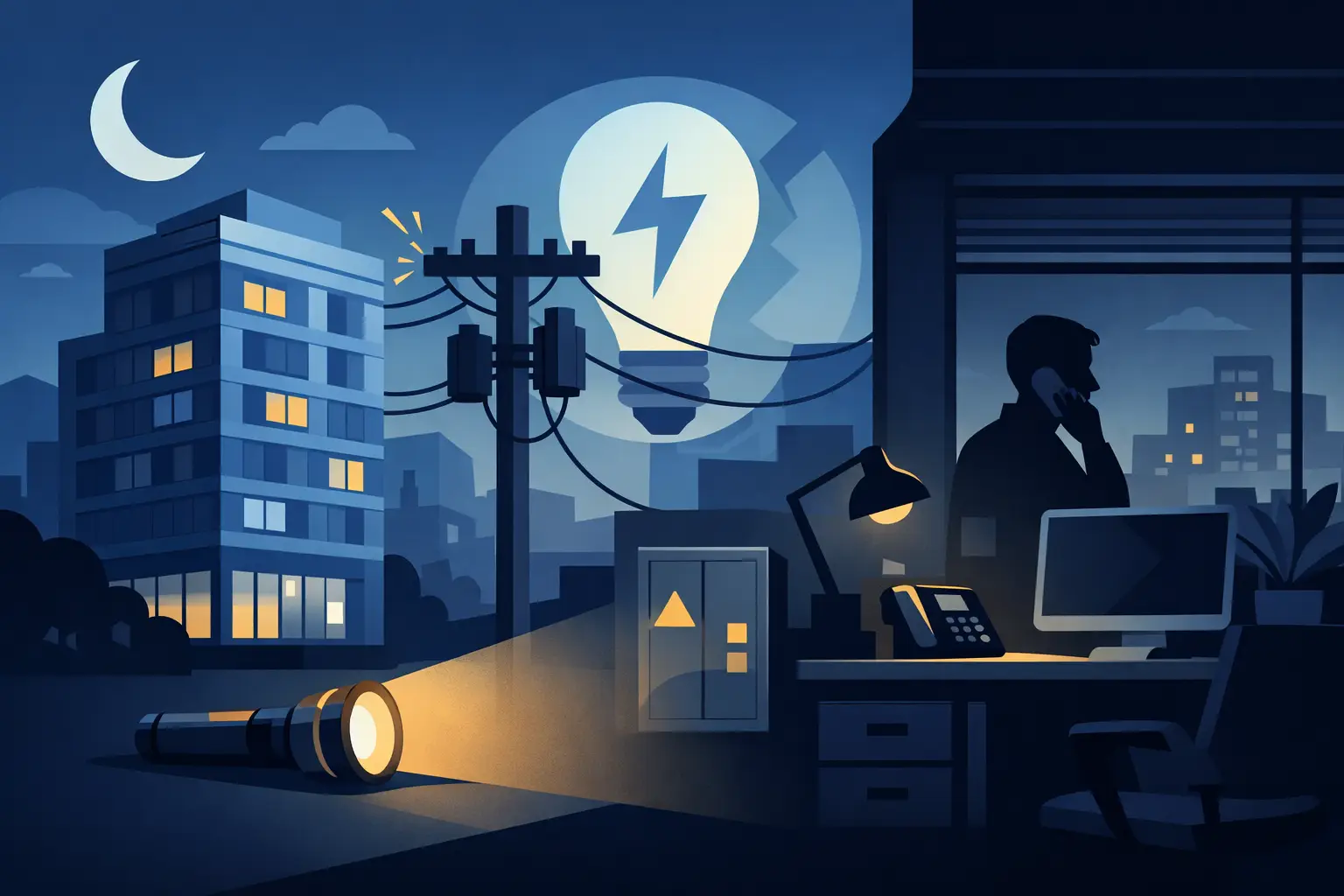
A power cut can stop a business faster than most people expect. Card terminals fail, shutters may not open, refrigerated stock starts warming, servers go offline, and staff are left trying to work out whether the problem is inside the building or affecting the wider area. This commercial power outage guide sets out the sensible steps to protect people, property, and day-to-day operations without taking unnecessary risks.
The right response depends on the type of premises and the equipment you rely on. A small office may need to protect data and communications first, while a restaurant, workshop, retail unit, or care setting may have stock, machinery, heating, security, or safety systems that need immediate attention. A clear plan removes guesswork when the lights go out.
First Actions During a Commercial Power Outage
Safety comes before keeping the business open. If there is a burning smell, smoke, visible damage, buzzing from electrical equipment, water near electrics, or repeated tripping, keep people away from the affected area. Do not reset breakers again and again in the hope that they will hold. Turn off equipment only if it is safe to do so, and arrange for a qualified electrician to investigate the fault.
Start by establishing the scope of the outage. Check whether neighboring buildings, street lighting, or nearby businesses have lost power too. If they have, the issue may be with the utility supply. If your building alone is affected, look at the main electrical panel for a tripped breaker or residual current device, but do not remove covers or attempt repairs.
A single tripped circuit can sometimes be caused by a faulty appliance or overloaded circuit. Before resetting it once, unplug portable equipment on that circuit where practical. If it trips again, leave it off. That is a useful warning that needs proper fault finding, not a reason to keep testing the system.
Assign one person to communicate with staff and customers. Clear, calm information prevents people from using lifts, opening refrigerated units repeatedly, switching machinery on and off, or trying to access restricted areas in the dark. If emergency lighting is not working, close off unsafe areas and consider whether the premises can remain open at all.
Protect People, Data, and Equipment
The first few minutes of an outage are the best time to prevent a manageable disruption becoming an expensive one. Shut down computers, servers, point-of-sale equipment, and sensitive machinery in the correct order if backup power gives you enough time. An unplanned loss of power can corrupt files, damage components, and create problems when power is restored.
Do not assume that a generator or battery backup means every circuit is safe to use. Many systems support only essential loads, such as emergency lighting, alarms, communications equipment, or selected IT hardware. Check what your backup supply is designed to carry before the emergency happens. Plugging heaters, kettles, tools, or extra appliances into a limited backup supply can overload it and cause another outage.
Refrigerated and frozen stock needs particular attention. Keep fridge and freezer doors closed as much as possible, record the time the power failed, and follow your food safety procedures before deciding whether stock can be kept. The same principle applies to temperature-sensitive medicine, laboratory materials, and specialist products.
Security should not be overlooked. Confirm whether CCTV, intruder alarms, access control, automatic gates, and fire alarm equipment have battery backup. A power cut can leave a property more vulnerable, especially if the outage happens after hours. If the building cannot be secured safely, consider arranging a physical check or temporary supervision until power and systems are restored.
Create a Commercial Power Outage Plan Before You Need It
A useful outage plan does not need to be a large manual that no one reads. It should be a short, practical document kept somewhere staff can access without the internet. Include emergency contacts, the location of the electrical panel, instructions for safely closing the premises, key equipment shutdown procedures, and a list of staff responsibilities.
For most small and medium-sized businesses, it helps to identify four priorities: life safety systems, critical operations, data and communications, and stock or equipment that could be damaged by temperature changes or sudden shutdowns. Once those are clear, it becomes easier to decide where backup power is worthwhile and where a simple shutdown process is enough.
Your plan should also cover who can make decisions. If the manager is away, staff need to know who can authorize closure, contact the utility provider, call an electrician, notify customers, or approve emergency spending. A plan that depends on one person being available is not much of a plan.
Test the plan occasionally. Ask staff what they would do if the power failed at opening time, during a busy service period, or overnight. A short walkthrough can reveal simple gaps, such as missing flashlight batteries, inaccessible keys, expired backup batteries, or no clear way to contact customers when the phone system is down.
Backup Power: Choose What You Actually Need
Backup power is valuable, but bigger is not automatically better. A battery backup unit can provide enough time for an orderly computer shutdown or keep a router running for a short period. A generator may be appropriate for a business that cannot safely stop operating, but it requires careful sizing, installation, fuel planning, ventilation, maintenance, and safe changeover arrangements.
Never connect a portable generator directly to a building’s wiring unless a properly installed transfer arrangement is in place. Back-feeding power into an electrical system is dangerous and can put workers, visitors, and utility crews at risk. Extension leads may be suitable for limited, temporary use in a safe dry area, but they are not a substitute for a designed backup system.
The right solution depends on the loads you need to support. Emergency lighting, internet equipment, a few computers, refrigeration, pumps, and production machinery all place very different demands on a backup supply. A qualified electrician can assess your installation, identify essential circuits, and explain the practical cost of keeping them available during an outage.
When the Power Comes Back On
Restoring power is not always the end of the incident. Supply can return with a surge, and equipment that restarts all at once may place a heavy demand on the electrical system. Where possible, bring larger loads back online gradually. Check for unusual noises, error messages, burning smells, tripped breakers, or equipment that fails to restart correctly.
Walk the premises before returning to normal operations. Check emergency lighting, fire and security systems, refrigeration, IT equipment, alarms, shutters, gates, and any machinery that was running when the outage occurred. If a system has been affected by the outage, do not bypass safety controls to get back to work sooner.
Record what happened while details are fresh. Note the start and end times, affected circuits or equipment, stock losses, actions taken, and any faults found. This can support insurance records, help with supplier discussions, and improve your response next time. It is also useful evidence for an electrician if the outage was caused by an internal fault.
Signs You Need an Electrician, Not Just a Reset
Call for professional help if the outage affects only your premises and a breaker will not stay on, especially if the fault follows a particular appliance, circuit, or area of the building. You should also arrange an inspection after water damage, electrical burning smells, sparks, damaged outlets, repeated flickering lights, or loss of power to essential systems.
Older commercial installations can struggle as a business grows. Extra computers, air conditioning, kitchen equipment, EV chargers, security systems, and machinery can gradually increase demand beyond what the original setup was designed to handle. Regular inspection, sensible circuit upgrades, and clearly labeled panels make faults easier to manage and can reduce the chance of a full shutdown.
A power outage is disruptive, but it should not leave your team guessing. Keep the plan clear, keep emergency supplies accessible, and treat repeated electrical faults as a warning worth investigating. A little preparation gives you a safer workplace and a much better chance of reopening with confidence when the power returns.