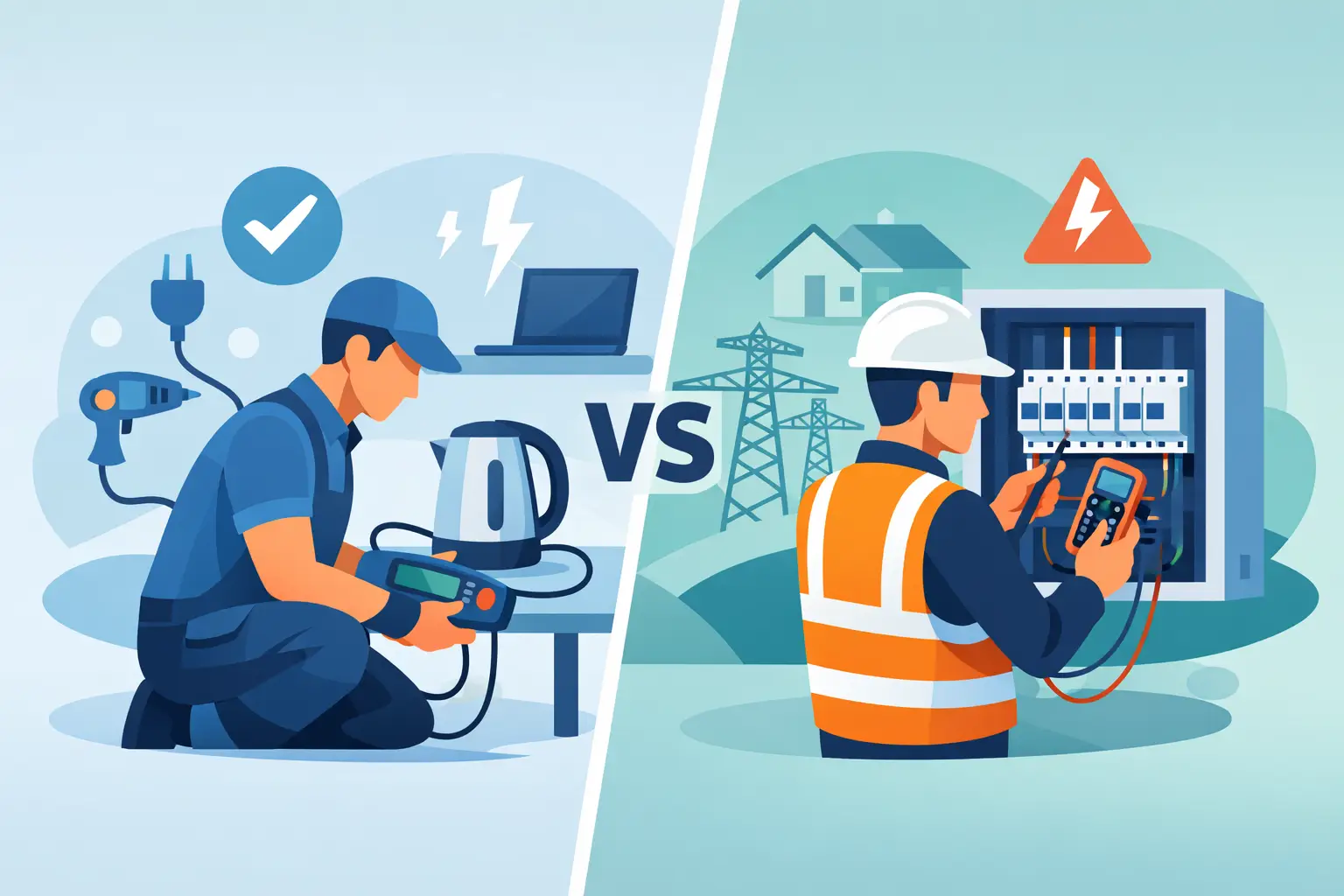
If you have been told you need PAT testing, an EICR, or both, it is easy to assume they are the same thing. They are not. When people compare pat testing vs eicr, they are really comparing two different checks that look at different parts of your electrical safety.
One focuses on portable appliances, such as kettles, monitors, printers, extension leads, and microwaves. The other looks at the fixed electrical installation in the building itself, including wiring, sockets, consumer units, and circuits. Both matter, but they serve different purposes and one does not replace the other.
PAT testing vs EICR – the basic difference
The simplest way to think about it is this. PAT testing checks electrical items you plug in and move around. An EICR checks the electrical system that powers the property.
So if a landlord, business owner, or property manager asks whether they need PAT testing or an EICR, the honest answer is often both, depending on the type of property and how it is used. A safe building still can have unsafe appliances. In the same way, a brand-new kettle does not tell you anything about the condition of the wiring behind the walls.
That distinction is where a lot of confusion starts. People hear the word “inspection” and assume any electrical check covers everything. It does not.
What PAT testing covers
PAT stands for Portable Appliance Testing. It is used to check that portable electrical items are safe to use. “Portable” does not always mean small enough to carry in one hand. It usually means an appliance that can be moved and is connected to the power supply by a plug.
Typical examples include computers, monitors, power tools, desk lamps, extension leads, fans, kitchen appliances, cleaning equipment, and chargers. In rental properties, this may include supplied white goods or any electrical items provided by the landlord. In workplaces, it can cover anything employees use day to day.
PAT testing usually includes a visual inspection first, because many faults are obvious before any meter is used. Cracked plugs, damaged cords, exposed wires, and signs of overheating are common examples. After that, electrical tests may be carried out to confirm the item is safe.
This matters because a lot of electrical risk comes from wear and tear. Appliances get dropped, cables get trapped, plugs get bent, and extension leads get overloaded. None of that would show up on an EICR.
What an EICR covers
An EICR is an Electrical Installation Condition Report. This is a formal inspection of the fixed electrical installation within a property.
It looks at the safety and condition of things such as the wiring, socket outlets, light fittings, protective devices, earthing, bonding, and the consumer unit. The aim is to identify damage, deterioration, defects, or anything that may no longer meet current safety standards.
An EICR is not about checking the toaster, the laptop charger, or the vacuum cleaner. It is about checking whether the electrical system in the property is safe for continued use.
That makes it especially important in older homes, rental properties, shops, offices, and commercial units where the installation may have been altered over time. Additions and repairs carried out over the years can leave hidden issues behind, even if everything appears to be working normally.
Why people often mix them up
Most customers are not electricians, so the mix-up is understandable. Both PAT testing and an EICR are electrical safety checks. Both can be relevant to landlords and businesses. Both may be mentioned during compliance conversations. But they are not interchangeable.
A common mistake is assuming PAT testing is enough because every appliance has a sticker on it. Another is assuming an EICR covers every electrical item in the building. Neither is right.
If you own or manage a property, it helps to split the question in two. First, is the building’s electrical installation safe? Second, are the electrical appliances being used safe? Once you look at it that way, the difference becomes much clearer.
Who typically needs PAT testing
PAT testing is most commonly associated with workplaces, rental properties, and public-facing premises. If appliances are provided for staff, tenants, or customers to use, there is a clear reason to check them regularly.
That includes offices with computer equipment, salons with hair tools, cafes with portable kitchen equipment, workshops using power tools, and landlords supplying electrical appliances in furnished rentals. In a small business, even a few everyday items can create risk if they are damaged or used heavily.
For homeowners, PAT testing is usually less formal and less commonly requested, but it can still be useful in certain situations. If you run a business from home, use portable tools regularly, or just want peace of mind about older appliances, it can still be worthwhile.
The frequency depends on the environment and the type of equipment. A desk lamp in a low-risk office is different from a power tool used daily on a job site. This is one of those areas where a sensible, practical approach matters more than a one-size-fits-all answer.
Who typically needs an EICR
An EICR is especially relevant for landlords, commercial property owners, and anyone responsible for a building used by others. It provides a clear picture of the installation’s condition and can highlight issues before they turn into faults, fire risks, or shocks.
Homeowners often book an EICR when buying a property, after major renovation work, when a home is older, or when there are warning signs such as tripping breakers, flickering lights, or outdated fuse boards. It is also a sensible check if it has been many years since the electrical system was last inspected.
For landlords, an EICR is often a key part of meeting safety responsibilities. For businesses, it is part of maintaining a safe environment for staff and visitors. For property managers, it helps avoid the bigger cost and disruption that can come from missed electrical problems.
PAT testing vs EICR for landlords and businesses
This is where the comparison matters most. Landlords and business owners are usually not asking out of curiosity. They want to know what they actually need to arrange and pay for.
If you are responsible for the building, an EICR checks the fixed installation. If you also provide appliances, PAT testing checks those supplied items. So a furnished rental may need both. An office with company-owned equipment may need both. A vacant unit with no portable equipment may only need the installation checked.
The detail depends on the property, who uses it, and what is being provided. That is why good advice starts with the setup of the building, not a generic checklist.
One does not replace the other
This is the key point. PAT testing does not tell you whether the property wiring is safe. An EICR does not confirm every plugged-in appliance is safe to use.
They work alongside each other. One covers the system. The other covers the equipment connected to it.
If you skip one because you have done the other, you may still be leaving a gap in safety. That gap might not be obvious until there is a fault, damaged equipment, or an avoidable incident.
How to know what you should book
Start with a simple question. Are you concerned about the fixed wiring and electrical installation, or the appliances people are using, or both?
If the issue is age of wiring, repeated tripping, outdated electrical boards, property purchase, landlord compliance, or general installation safety, you are likely looking for an EICR. If the concern is portable equipment in a workplace, rental property, or business setting, PAT testing is likely the right fit.
In many cases, especially for landlords and small businesses, both checks make sense because they cover different risks. A straightforward electrician will explain what applies to your property without trying to oversell work you do not need.
That is usually the best approach – practical, clear, and based on how the space is actually used. At BS Electrical, that is how we look at it. If you are not sure which inspection is right, the best next step is simply to ask and get honest advice before a small issue turns into a bigger one.