
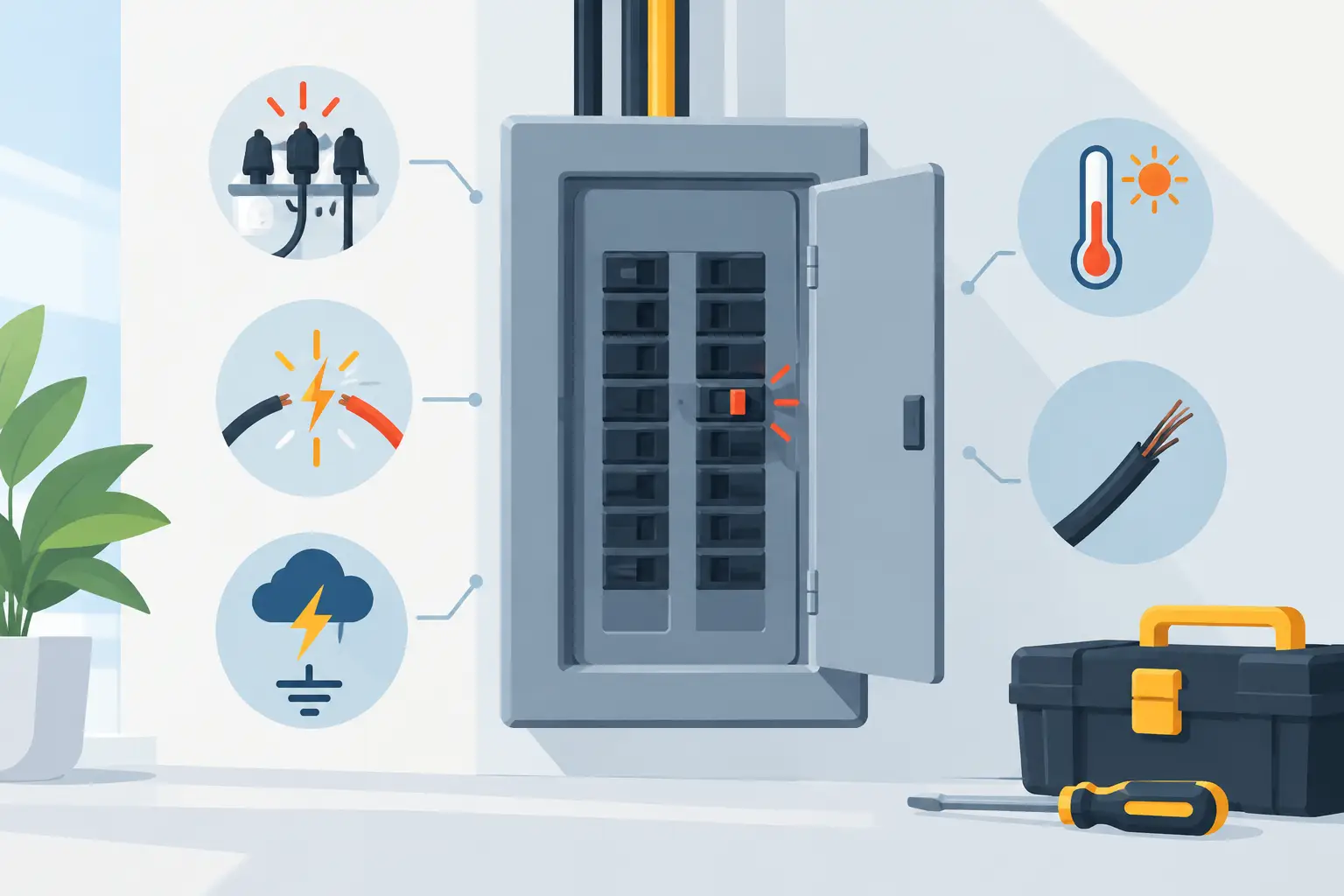
A breaker that trips once can be frustrating. A breaker that keeps tripping is your electrical system telling you something needs attention. So, why do circuit breakers trip? Usually, they are doing exactly what they are designed to do: cutting power before overheating, damaged wiring, or a fault creates a more serious safety risk.
The key is not to treat a tripped breaker as an inconvenience to be forced back on. The pattern of when it trips, what was running at the time, and whether it resets can help narrow down the cause. Some issues are as simple as too many appliances on one circuit. Others need professional fault finding before the circuit is used again.
What a Circuit Breaker Is Meant to Do
A circuit breaker protects the wiring in your home, rental property, or business. Every circuit is designed to carry only a certain amount of electrical current. If that limit is exceeded, or electricity starts flowing where it should not, the breaker disconnects the supply.
That protective action helps prevent cables from overheating inside walls, outlets, ceilings, and appliances. It may feel like the breaker has failed, but in many cases it has prevented a much larger problem.
A breaker can trip because of an overload, a short circuit, a ground fault, or a fault within the breaker or electrical panel itself. The right repair depends on which of these is happening. Repeatedly resetting the breaker without finding the reason is never a sensible fix.
The Most Common Reasons Circuit Breakers Trip
An overloaded circuit
Overloads are one of the most common causes. They happen when several appliances draw more power than the circuit can safely handle. Kitchens, utility rooms, garages, workshops, and offices are frequent trouble spots because they often have high-demand equipment plugged into the same circuit.
For example, a microwave, toaster oven, coffee maker, and kettle can place a heavy load on a kitchen circuit. In a workshop, a space heater, compressor, charger, and power tools can do the same. The breaker may trip after several minutes rather than immediately because the cable and breaker are heating up as the load continues.
Unplugging a few items may stop the immediate issue, but it is worth considering whether the space has enough circuits for how it is actually used. Extension cords and power strips can add outlets, but they do not increase the capacity of the circuit behind them.
A short circuit
A short circuit occurs when a live wire comes into contact with a neutral wire, creating a low-resistance path for electricity. This causes a sudden spike in current, so the breaker normally trips right away.
Damaged appliance cords, loose connections, faulty outlets, pinched cables, and wiring damage can all cause a short. You may notice a burning smell, discoloration around an outlet, crackling, or a visible spark. If you see or smell any of these signs, leave the breaker off and arrange for an electrician to inspect it.
A short circuit is not a situation to troubleshoot by taking outlets apart yourself. The damage may be out of sight, and the cause is not always where the symptoms first appear.
A ground fault
A ground fault happens when live electricity finds an unintended path to ground, often through metalwork, damp materials, or a damaged cable. These faults are particularly common in bathrooms, kitchens, basements, laundry areas, garages, and outdoor circuits where moisture is more likely.
Modern protection devices are designed to react very quickly to this type of fault because it can create a shock risk. If a breaker trips when using an outdoor outlet, pressure washer, bathroom appliance, or appliance near a sink, moisture or damaged equipment could be involved.
Do not assume that a circuit is safe just because it works again after drying out or resetting. Water ingress, condensation, cracked outlet covers, and worn cables can lead to intermittent faults that return at the worst possible time.
A faulty appliance
If the breaker trips only when one appliance is plugged in or switched on, that appliance is a strong suspect. Common examples include older refrigerators, freezers, washing machines, dryers, dishwashers, electric heaters, and power tools. Their motors, heating elements, plugs, or internal wiring can develop faults over time.
A simple, safe check is to unplug everything on the affected circuit, reset the breaker once, then plug appliances back in one at a time. If the breaker trips when a particular item is connected or started, stop using it until it has been repaired, tested, or replaced.
This approach has limits. Some appliances fault only once they heat up or start a motor cycle, so a circuit that appears fine for a few minutes may still have a problem. If you are unsure which items are on the circuit, an electrician can identify the cause without guesswork.
Damaged or aging wiring
Older properties can have wiring that has been altered many times, overloaded over the years, or damaged by drilling, pests, damp, or poor previous work. Loose connections are especially concerning because they create heat where wires meet terminals, outlets, switches, or the electrical panel.
You might notice lights flickering, outlets that feel warm, intermittent tripping, buzzing sounds, or a breaker that trips with very little load. These are all good reasons to book an inspection. The fault could be hidden behind a wall or above a ceiling, and it needs to be located properly rather than covered up.
A worn breaker or panel issue
Breakers are mechanical safety devices and can wear out. A faulty breaker may trip too easily, fail to stay reset, or become hot. However, a breaker should not be blamed until the circuit it protects has been checked. Replacing a breaker without resolving an overload or wiring fault can leave the original danger in place.
Older electrical panels can also struggle to meet the demands of modern homes and businesses. Added appliances, home offices, electric heating, air conditioning, EV charging, and equipment upgrades can all change how much capacity a property needs. In these cases, a panel upgrade or additional circuits may be a better long-term answer than living with regular trips.
What You Can Safely Check First
If a breaker has tripped, start by switching off or unplugging devices on the affected circuit. Open the electrical panel, find the breaker that has moved to the middle or off position, push it fully to off, then reset it to on. Some breakers need that full off movement before they will reset.
If it stays on with everything unplugged, reconnect items gradually. This can reveal an obvious faulty appliance or an overloaded circuit. Make a note of what was in use when the trip happened, especially if it happens at a particular time or when a certain piece of equipment starts.
There are a few things not to do. Do not hold a breaker in the on position, tape it in place, fit a larger breaker, or keep resetting it over and over. Do not remove the panel cover or work on wiring. A larger breaker does not provide more safe power unless the wiring and circuit design are suitable for it. It can allow cables to overheat before protection operates.
When to Call an Electrician
Call a qualified electrician if the breaker trips immediately after resetting, trips repeatedly with nothing plugged in, or if there are signs of heat, smoke, burning, buzzing, sparking, or water damage. The same applies when an outlet, switch, or electrical panel feels warm, or when the affected circuit serves essential equipment such as a refrigerator, heating system, security system, or business equipment.
For landlords and property managers, recurring breaker trips should be dealt with promptly. Tenants may respond by using extension cords from other rooms, which can introduce another overload risk and leave the original fault unresolved. A proper inspection provides a clearer record of the issue and the repair completed.
In commercial spaces, the cause may be more complex. Equipment startup loads, lighting controls, refrigeration, IT equipment, and machinery can all affect a circuit differently. Fault finding should account for how the premises are used, not just whether the breaker resets during a quick visit.
BS Electrical takes a straightforward approach: identify why the protection is operating, test the circuit and connected equipment where needed, explain the findings clearly, and carry out the right repair. That may be a small repair, a replacement outlet, a new dedicated circuit, or a wider upgrade. It depends on the fault, the age of the installation, and the demands being placed on it.
A breaker that trips is asking for attention, not a workaround. Leaving it off until the cause is properly understood is often the safest and cheapest decision in the long run.