
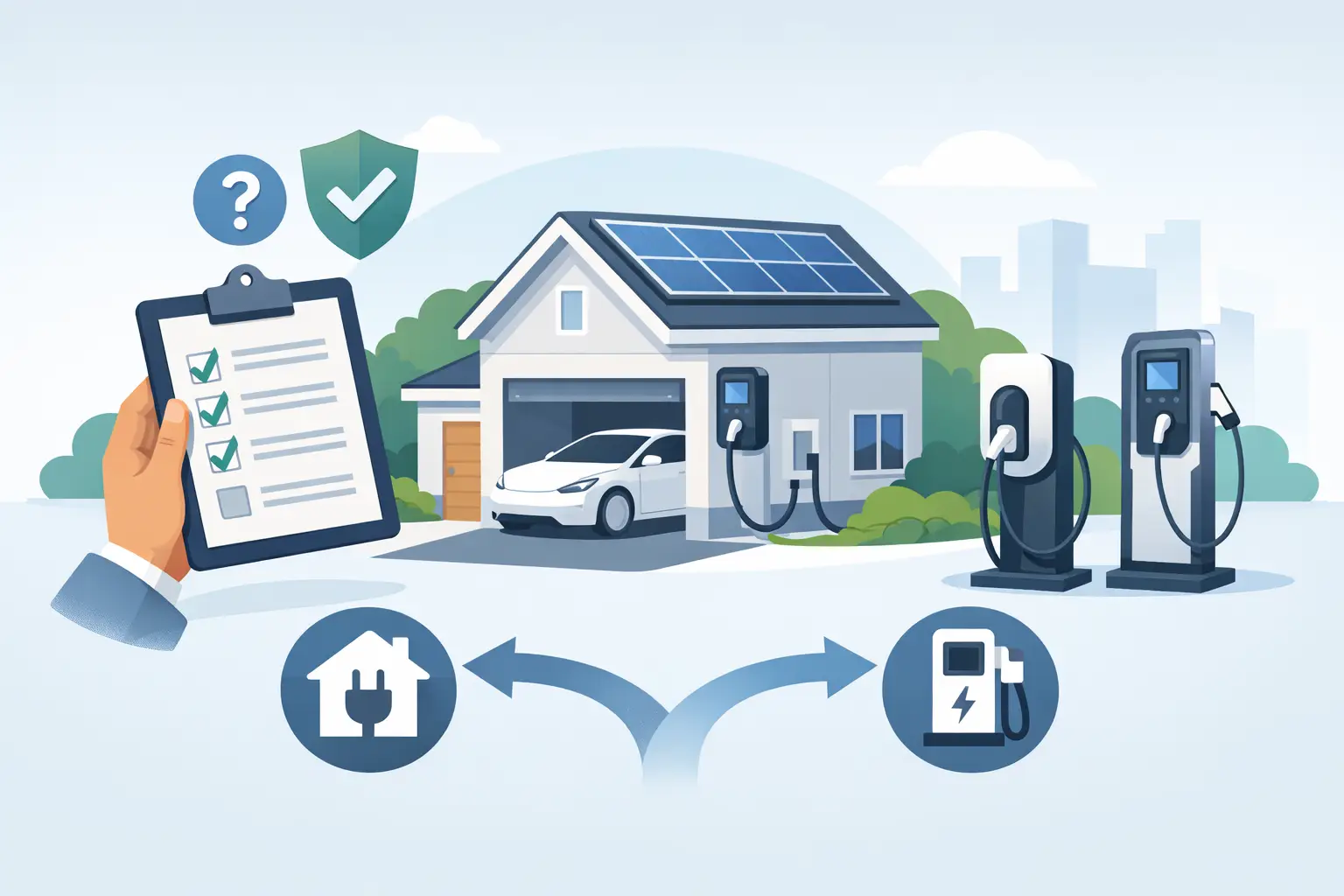
A home charger should suit the way you actually use your car, not just look good on the wall. If you are wondering how to choose ev charger equipment for your property, start with your vehicle, your parking space, and the electrical supply already in place. The right choice makes daily charging simple; the wrong one can mean slow charging, an awkward cable run, or unnecessary expense.
For most households, a properly installed home charger is more convenient and dependable than relying on a standard outlet or public charging points. But charger ratings, connector types, and smart features can make the decision feel more complicated than it needs to be.
Start with your car and driving routine
Before comparing chargers, check what your EV can accept. Every electric vehicle has a maximum AC charging rate, and installing a charger rated above that limit will not necessarily make the car charge faster. A charger can still be a sensible future-proofing choice if you expect to change vehicles, but it should not be the only reason to spend more.
Think about how far you drive on a typical day. If your car is usually parked overnight, you may not need the highest available charging speed. A charger that comfortably replenishes your normal daily mileage while you sleep is often the practical option. Faster charging can be useful for high-mileage drivers, households with more than one EV, or business premises where vehicles need to turn around during the day.
It also helps to consider when the car is at home. Someone who works nights, for example, may need a different charging schedule from someone who plugs in every evening. The best charger is one that fits your routine without becoming another thing to manage.
Choose the right charging speed
Home EV chargers are commonly available in different power ratings. Higher power can reduce charging time, but only where the vehicle and property electrical supply can support it.
A lower-powered unit may suit a smaller battery, modest daily mileage, or a property with limited electrical capacity. A higher-powered charger can be a better fit for larger batteries and frequent drivers, provided the installation has been assessed properly. It is not just a case of choosing the biggest number on the box.
The supply to the property matters. Your electrician should check the condition and capacity of the existing electrical installation, including the consumer unit or fuse board, earthing arrangements, and the route for the new cable. Older properties sometimes need additional work before an EV charger can be installed safely. Finding that out before choosing a unit helps avoid surprises on the day.
Tethered or untethered: consider everyday convenience
One of the first decisions is whether you want a tethered charger, with a charging cable permanently attached, or an untethered unit that uses the cable supplied with your vehicle.
A tethered charger is usually the easiest option for home use. You arrive, park, and plug in. There is no need to take a cable out of the trunk each time, and the cable can be neatly stored on the unit when not in use. Make sure the cable is long enough to reach your charge port without being stretched across a walkway or driveway.
An untethered charger can look tidier and may give more flexibility if different vehicles use different connector types. It can also be useful where the cable needs to be stored away after use. The trade-off is that you need to handle and carry the cable more often. For a single-car household that charges at home regularly, tethered is often the more convenient choice.
Get the charger location right
Where the charger sits can matter as much as which model you buy. The ideal location is usually close to where the vehicle parks, with a safe and direct cable route from the electrical supply. It should allow the cable to reach the charging port without crossing public paths, creating a trip risk, or getting trapped under doors.
Do not assume the charger must be mounted directly beside the driveway. Sometimes a position on a garage wall, side wall, or purpose-built post provides a cleaner and safer installation. Your electrician can advise on cable routing and whether any outdoor equipment needs additional weather protection.
For shared driveways, rental homes, apartment blocks, and commercial sites, access becomes especially important. Think about who will use the charger, where each vehicle will park, and whether the arrangement will still work if your circumstances change. A little planning now can prevent a costly relocation later.
Decide whether smart features are worth it
Many modern chargers include smart controls through an app. These can allow you to schedule charging, monitor energy use, view charging history, and sometimes adjust charging around household demand. If your electricity provider offers cheaper off-peak rates, scheduled charging can be a genuinely useful feature.
Smart control is not essential for everyone. If you simply want to plug in overnight and leave the car to charge, a reliable, straightforward unit may be all you need. However, it can be worthwhile for drivers who want to track costs, charge at specific times, or manage more than one EV.
Look beyond the app itself. Check that the charger can still operate sensibly if your internet connection drops, and ask how software updates are handled. A useful smart charger should make charging easier, not leave you dependent on your phone for basic operation.
Think ahead, but do not overbuy
Future-proofing is sensible, especially if you expect to replace your EV in a few years or add a second electric car. Choosing a charger with enough capacity for likely future needs can save disruption later. So can installing cable routes or provision for an additional charger while other electrical work is being carried out.
That said, future-proofing should be realistic. Paying significantly more for power your current electrical supply cannot support, or features you will never use, is not good value. An experienced electrician can explain the options clearly and help you balance today’s budget with tomorrow’s plans.
Do not overlook safety and installation quality
An EV charger is a high-load electrical installation, not an appliance to treat as a simple plug-and-play purchase. The unit needs correctly sized cabling, suitable protective devices, proper earthing, and testing once the work is complete. The installation should also take account of the property’s overall electrical condition.
This is particularly relevant if your fuse board is older, you have had electrical issues in the past, or your home already has high-demand equipment such as electric heating, a hot tub, or a workshop. Load management may be recommended in some cases. This helps the charger work alongside the rest of the property’s electrical demand without overloading the supply.
For landlords and business owners, the job also needs to work for the people using the space. Clear cable management, sensible access, durable equipment, and an easy handover all matter. A charger that is technically installed but awkward to use will soon become a frustration.
Compare the full installation quote
When comparing quotes, make sure you are looking at the complete job rather than just the price of the charger unit. A proper quote should make clear what is included: the charger, cabling, mounting, protective equipment, testing, certification, and any additional work identified during the assessment.
Cheaper is not always better if the quote leaves out the work needed to install the charger safely. Equally, you should not be pushed toward upgrades that have not been properly explained. Ask why a recommendation has been made and what alternatives are available. Honest advice should be straightforward and easy to understand.
At BS Electrical, the aim is to assess the property properly, explain the practical options, and install a charger that suits the customer rather than a one-size-fits-all package. That approach is especially valuable in older homes and busy commercial premises, where the existing electrical setup can vary widely.
Questions worth asking before you buy
A quick conversation with a qualified installer can save time and money. Ask whether your current electrical supply can support the charger you want, what charging speed your vehicle can use, and whether your cable length will work with the parking layout. It is also worth asking about smart scheduling, future expansion, warranty arrangements, and what certification you will receive when the work is finished.
Take a few photos of the parking area, your electrical panel, and the likely cable route before requesting a quote. They can give the electrician a clearer picture at the start, although an on-site assessment may still be needed for more involved installations.
A good EV charger should quietly make ownership easier: park up, plug in, and wake up ready to go. Choose the unit around your real driving habits, then make sure the installation is done properly, first time.